Hi, kids!
It’s time once again to turn a jaundiced eye toward the news and newsmakers of the day who, in my cynical opinion, either contributed to our quality of life or detracted from it in some significant way:
The Sins of the “Chisler” Return…
This week banged up and bandaged residents of ICI Homes’ Mosaic subdivision west of LPGA Boulevard finally had their voices heard on a point of community concern:
According to reports, the sidewalks in the development were installed improperly and have created something of a ‘Slip-n-Slide’ effect for homeowners tired of falling down and busting their ass (literally) when attempting to walk the neighborhood…
More disturbing, an inquiry by the City of Daytona Beach found that approvals for the sidewalks were apparently pencil whipped by former City Manager Jim “The Chisler” Chisholm with little, if any, documentation to show inspections were performed.
In an important exposé by reporter Eileen Zaffiro-Keen writing in The Daytona Beach News-Journal this week, assistant city manager for infrastructure Andy Holmes, explained “Former Daytona Beach City Manager Jim Chisholm, who served from 2004 until 2021, decided unilaterally whether a bond would be reduced or released, Holmes said. Chisholm also decided whether a newly constructed street or sidewalk would be accepted, he said.
Chisholm oversaw Mosaic sidewalk construction from 2017 until 2021, and there are no city inspection records of that work during that period, Holmes said.”
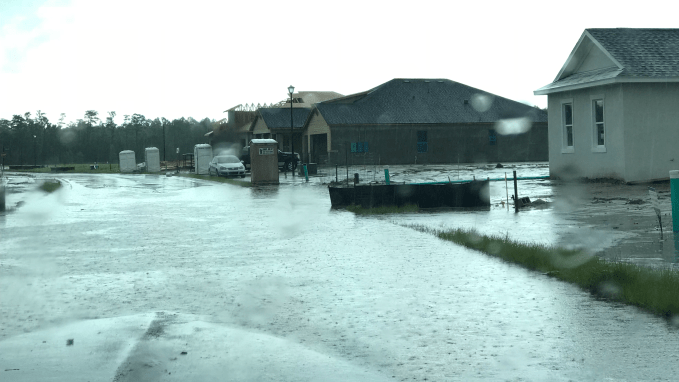
As a result, the sidewalks are holding water – resulting in ponding and the resultant slimy residue that has caused “more than 40 people in the Mosaic neighborhood” to slip and fall onto the slippery concrete, including one resident who “broke her tailbone” during a tumble.
Whoa.
“Because Chisholm apparently released bonds on at least some sections of the Mosaic sidewalks residents are complaining about, the city is responsible for the condition of those sidewalks. Whoever ICI hired to do that work is in the clear.
“It’s distasteful to me,” Holmes said. “The city didn’t build any of those sidewalks wrong. But legally, the city signed off on them.”
According to the report, “Chisholm could not be reached for comment.”
That’s classic. The “Chisler” answers to no one…
In addition to the physical injuries sustained by residents, the revelations must come as a godawful embarrassment for our High Panjandrum of Political Power and ICI Homes founder Mori Hosseini – a titan of the development industry – who is widely considered one of the most powerful and influential people in Florida.
Look, I won’t speculate on why former City Manager Chisholm would approve millions of dollars in substandard sidewalks in Mosaic without documented inspections. That represents key infrastructure that residents rely on to safely navigate their neighborhood.
In my view, something stinks…
To his credit, since taking the helm in 2021, current City Manager Deric Feacher has ensured that his conscientious staff conduct and document proper inspections. Reports indicate there have been no issue with city recordkeeping since Mr. Feacher assumed command.
According to the News-Journal’s report, Mayor Derrick Henry is none too happy with the prospect of Daytona Beach taxpayers being placed on the hook for an estimated $1 million in extensive sidewalk reconstruction.
In addition to the cost of replacing the defective stretches of sidewalk, the restoration efforts will require a massive amount of staff time to determine who is responsible for what, then coordinate the logistics of a disruptive construction project with a lot of moving parts.
“To the folks at Mosaic, I’m sorry that you had to experience that,” said Mayor Derrick Henry. “Somewhere along the way, somebody down here (in the Daytona city government) didn’t do their job. We kind of know who it was, but I’m very disappointed. We are going to do our part and do what we have to, to hold them accountable.”
Thank you, Mayor Henry.
It’s about time a local government started holding those in positions of responsibility (with an enormous salary to match) accountable their five-alarm foul-ups that leave taxpayers holding the bag.
In my view, Daytona Beach City Commissioner Stacy Cantu is the true hero of this story. Upon learning of the danger, she took up the cause of her constituents in Mosaic and ensured that a complex plan was implemented that will ultimately make at-risk residents whole.
That’s responsive representation. I admire that.
Now that the incredibly expensive sins of Jim Chisholm – who made a career of diligently catering to our “Rich and Powerful” while telling downtrodden residents of Midtown to get out if they didn’t like their homes being flooded every time it sprinkles – are coming to light, here’s hoping someone from a state/federal agency with a badge in their wallet conducts a complete investigation.
In my view, shoddy sidewalks are one thing, but Mosaic residents are coming forward with ominous reports that their side yards look like a “marsh” – with visible standing water – as others complain about the poor workmanship evident in the development’s infrastructure.
What is the extent of the city’s substandard, undocumented, or non-existent inspections in Mosaic and elsewhere on Chisholm’s watch?
Has anyone ensured that the plethora of new construction between 2004 to 2021 was thoroughly inspected to insure the new homes and apartments met building codes?
If visible infrastructure like sidewalks is dangerously inferior, how can homebuyers be assured that their property is free of internal hazards, structurally sound, and compliant with established construction standards?
Is this the tip of an extremely big (and incredibly expensive) iceberg?
I’m asking – before an aggressive personal injury attorney does…
According to the News-Journal’s report, one concerned Mosaic resident asked the million-dollar (at least) question, “Who signed off that this sidewalk passed inspection? Had they been doing their job, the city would have caught this. Who’s sleeping at the city and not holding these builders accountable?”
Disturbing questions that deserve answers…
The Unraveling of Ormond Beach Mayor Jason Leslie – A Case Study in Power Politics
Following the disastrous budget process in Ormond Beach, a weird kabuki that seemed to have half the town begging for a tax increase and the other demanding substantive cuts (with a last-minute twist that left everyone shaking their heads), we’ve learned two things:
Mayor Jason Leslie is not a politician.
Unfortunately, he’s not a statesman, either…
As a frequent apologist for Mayor Leslie, I’m not going to sugarcoat this – he got played like a fiddle – ultimately beaten into the round hole of conformity like a henpecked eunuch.
The sense of fremdschämen I felt watching it unfold was overwhelming…
Hell, even his former opponent – the perennial politician Susan Persis – who Leslie beat like a gong with 53% of the vote in last year’s mayoral race, came down from the political ash heap to put the boots to him at the podium last week.
In her L’esprit de l’escalier moment, Persis condescendingly lectured Leslie, “During your short, turbulent time as mayor, you have demonstrated a propensity of taking positions in front of a certain audience and then taking the opposing position in front of another audience.”
In the leadup to the final vote on the budget, Ormond Beach residents received a glossy mailer screaming “No new taxes” – it was paid for by a once staunch supporter of Mayor Leslie, the politically active George Arnold.
The provocative flier announced, “Mayor Jason Leslie says, ‘No New Taxes.’ Make sure to tell these arrogant, clueless, out of touch tax & spend commissioners where they can go with their big tax and spend scheme.”
The reverse identified the remaining Ormond Beach City Commissioners by name…

During last Wednesday’s meeting, Mayor Leslie disingenuously claimed he was “shocked” when he received the mailer, explaining he knew nothing about it. Then, in an interview with the Ormond Beach Observer, Mr. Arnold countered that he told Mayor Leslie about the flier well ahead of when it was sent.
Yeah. I know…
“He’s a flip-flopper,” Arnold said. “… He’s easily cowed. He’s desperate to be liked, and you can’t have both. You either stand on your principle or you cave, and he folded like a cheap suit.”
Arnold said Leslie had “a great opportunity to do things for Ormond Beach” but that he’s been a “big disappointment.”
“He’s not to be trusted and it’s a shame,” Arnold said. “I hate to say that because I backed him, but I never stick with a mistake.”
Sadly, Mr. Arnold is right.
After being repeatedly bludgeoned by his cliquish “colleagues” on the dais, Mayor Leslie must have naively thought his last-minute capitulation fulfilled his promise to “work together” with his antagonists?
Instead, by giving in and going along, Mayor Leslie has painted himself into a tight political corner and he has no one to blame but himself…
During the abject shitshow that passed for the budget process, the techy trio of Commissioners Travis Sargent, Lori Tolland, and Kristin Deaton repeatedly portrayed Mayor Leslie as irresponsible and out-of-touch for keeping his campaign promises and suggesting substantial budget cuts.
In turn, City Attorney Randy Hayes crafted a fright-filled missive calling any budget reductions a minefield of “financial risks and liabilities,” suggesting Mayor Leslie’s opposition to a tax increase was counter to “sound fiscal management and responsible leadership.”
(I’m assuming after politicizing his office City Attorney Hayes will be retiring soon?)
Then – literally at the eleventh-hour – last Wednesday, Commissioner Sargent rode into the chamber on a white steed and declared, “I don’t think the ship has sailed. I think we have options. It takes a lot to go through this and to come up with these, because I don’t want to cut any services. This is a plan that will provide the residents with the services they expect and not have to pay additional taxes.”
Had Mayor Leslie done that, he would have been pilloried outside City Hall and given the bastinado treatment…
After some back-and-forth, the Commission made a few nicks in the budget before unanimously voting to approve a millage rate of 4.3832 mills, which represents a 5.3% increase over last year.
That didn’t sit well with many Ormond Beach residents – one of whom called the last-minute push by Commissioner Sargent “a disgrace and an embarrassment to the city of Ormond Beach,” while others are clamoring that the reductions weren’t near enough.
What’s done is done.
That said, I believe the bizarre manner and means by which the City Commission and senior staff arrived at the final budget will resonate with Ormond Beach voters well into next year’s elections.
Now, Mayor Leslie’s disheartened supporters – those who saw him as a maverick newcomer, a change agent unbeholden to Volusia’s ‘Old Guard,’ someone willing to challenge the stagnant status quo to bring spending and development under control – are rightfully incensed that he rolled over, surrendered, and voted with the majority to raise taxes.
In my experience, voters can forgive many transgressions, but they are revolted by the stench of hypocrisy – that sickening feeling of being hoodwinked for political expediency by someone they trusted to do the right thing, for the right reasons.
After his self-inflicted turnabout, Mayor Leslie has a long way to go to find an authentic voice, demonstrate leadership, and regain the trust of his constituents.
Quote of the Week
“(Senate Bill 180) …gives developers legal ammunition to sue a city or county that tries to slow suburban sprawl, save rural areas, or protect environmentally sensitive places — or anything else that a developer can claim is “restrictive or burdensome.”
That’s the part of Senate Bill 180 that Pat Neal, Carlos Beruff and the homebuilding lobby are trying to use to stop Manatee County from increasing impact fees.
“The resulting increase in impact fees are restrictive and burdensome to plaintiffs and customers of plaintiff’s businesses,” their lawyers claim in the complaint, which has been filed in Manatee County Circuit Court.
Manatee is now defending itself. And one of the county’s main legal arguments is that the prohibition against “more restrictive or burdensome” land-use rules doesn’t apply to impact fees.
“Impact fees do not regulate or control the development of land in the county, but merely impose a fee to fund capital facilities needed to accommodate new development,” attorneys for Manatee County wrote in an Aug. 12 legal brief. “In short, impact fees do not control how an owner may use land.”
That’s when Ron DeSantis stepped in.
On Aug. 15 — three days after Manatee County submitted its legal brief — the head of the Florida Department of Commerce sent an entirely-out-of-the-blue letter to county leaders warning them not to go forward with their plan to raise impact fees.
Why? Because the increase “appears to potentially violate” Senate Bill 180, the agency claimed.”
–Jason Garcia, writing in his Seeking Rents newsletter, “Ron DeSantis is helping real estate developers exploit a hurricane relief law,” Sunday, September 21, 2025
If anyone is still laboring under the mistaken impression that Senate Bill 180 was innocently designed by the Florida legislature to cut red tape for homeowners following a hurricane, a recent lawsuit filed in Manatee County on behalf of developers attempting to stop an increase in impact fees should clear up any lingering confusion.
It is now clear that the purpose-built overreach of Senate Bill 180 was calculated to subvert local government’s ability to regulate growth, essentially gifting the real estate development industry carte blanche under threat of crippling lawsuits – and brazen intimidation by allied senior state officials who target anyone who dares stand in their way.
Incredibly, now the broad provisions of SB 180 are being used to stop cities and counties from increasing impact fees.
Based upon the lawsuit filed in Manatee County on behalf of development interests, the subjective “restrictive and burdensome” language of SB 180 is being extrapolated to include the means by which new construction is supposed to help pay for its myriad impacts on a community’s infrastructure and essential services. Something that has nothing to do with controlling growth, regulating development, or facilitating hurricane relief and recovery.
Just days after Manatee County submitted its commonsense defense, in a chilling move, the Florida Department of Commerce sent county officials a frightening warning not to move forward with plans to increase impact fees.
Scary.
As the layers of this rotten onion are peeled, it becomes increasingly evident that our legislators intentionally allowed their political benefactors in the development industry to usurp local control.
Now, it appears state officials are employing not-so-veiled threats of removing local officials from office, draconian edicts by regulatory agencies, and the coercive (and horribly unethical) pressure of withholding state funding for local road, parks, and economic development projects to secure the profit motives of their political donors…
Read that again.
As Mr. Garcia alarmingly cautioned, “I don’t want to be melodramatic here, but this could well be the last stand for home rule in Florida.
Land-use is arguably the one major policy area where cities and counties have lots of autonomy and power.
And if politicians in Tallahassee can strip locally elected leaders of even that power…there’s probably no bottom to this.”
I don’t care what your political persuasion is, this isn’t good governance – it’s state-sponsored gangsterism.
That should frighten the hell out every resident – and local elected representative – in the State of Florida…
And Another Thing!
“Flagler County, Flagler Beach, and Palm Coast invest taxpayer dollars in economic development for situations exactly like this. It is unacceptable for a company to take advantage of our resources, uproot families and walk away without accountability. Brunswick owes this community more than a press release and a moving truck.
We are not powerless. Our leaders can and likely will press Brunswick for answers, demand negotiations, explore incentives, and make clear that leaving is not an option. Period. And as a community, we must make sure our leaders know we have their backs in this fight.
Let’s send a clear message to Brunswick: absolutely not. You cannot come and go at will, leaving Flagler families and businesses in the lurch. Not after everything this community has done to support you. This time, we stand together to say enough is enough.”
–Ken Belshe, a principal at Sunbelt Land Management, the developer of Veranda Bay in Flagler Beach, as excerpted from his op/ed “Hell No: Boston Whaler Should Not Be Allowed to Exit Without a Fight from Flagler County’s Leadership,” FlaglerLive.com, Friday, September 19, 2025
It’s no secret I’m an excitable sort.
When something really gets my dander up, I frequently write down my frustrations – furiously purging my craw on paper – venting my anger and exposing my fears to no one in particular.
It’s part of the wonderful catharsis of writing.
Once I’ve transferred my negative feelings to the page, I sleep on it.
Invariably, when I come back and review my often-incoherent ravings, I crumple up the paper and place it in the round file, feeling infinitely better for the expressive release without having embarrassed myself by publishing some half-baked and emotionally charged diatribe to the world.
Perhaps Flagler County developer Ken Belshe should give that anger management strategy a try?
After reading Mr. Belshe’s editorial in FlaglerLive! last week, I find it hard to believe that a savvy business executive who overcame significant opposition from residents and environmentalists to get what he wanted when seeking approvals for Veranda Bay has such a myopic view of the realities of a free marketplace.
That said, Mr. Belshe makes an excellent point on how some corporations take advantage of publicly funded “economic development” incentives to cover overhead, then flee like scalded dogs when it becomes financially advantageous, leaving taxpayers holding the empty bag (and moldering building).
The fact is, Brunswick can “come and go” as it deems necessary to remain competitive.
Look, I realize Florida developers are accustomed to getting their way on every issue large and small, but absent a legal obligation tied to the economic incentives that lured them here (which rarely happens), there is no duty for a company to remain rooted in Flagler County – or anywhere else – and slowly wither on the vine when market conditions change.

In my view, Mr. Belshe should take a long look in the mirror when he starts making demands of other Flagler County business interests.
As I recall, he was just as unreceptive to public outcry when maneuvering to develop 900 acres of sensitive wildlife habitat along the Intracoastal Waterway near Bulow Creek. A controversial project that will ultimately bring some 2,700 homes to the development known as Veranda Bay.
That irony is not lost on Flagler County residents…
In response to Mr. Belshe’s op/ed, a citizen identified as “Mr. David” satirically suggested, “Ken, step up to the plate for the county and all the disenfranchised workers! You could provide hundreds of homes from your development at no cost to the unemployed! After the environmental disaster that is Veranda Bay, it would be the least you could do.”
Four years after returning to Flagler County, Brunswick’s Boston Whaler manufacturing operation is being consolidated with its Edgewater facility. The closing will result in the loss of some 300 jobs, all of which are being offered transfers to the new operation.
According to reports, Brunswick officials said the relocation is due to a five-year downturn in the fiberglass boat retail market.
In 2007, desperate for those elusive “high paying jobs,” Flagler County cobbled together a multifaceted “Economic Incentive Program,” including capital funding, infrastructure improvements, and real estate discounts, to entice the original Sea Ray plant to Flagler County.
There were no guarantees, then or now, and Sea Ray closed the plant in 2018.
Brunswick reopened the facility three-years later to manufacture Boston Whaler products.
According to a January 2021 report by Clayton Park writing in The Daytona Beach News-Journal, both Brunswick and Palm Coast officials confirmed that “No economic incentives were involved in Brunswick’s decision to take its Sea Ray property off the market to convert it into a Boston Whaler plant…”
In my view, the unfortunate closing of the Brunswick plant and the displacement of its Flagler based employees is one more example of why government should get out of the marketplace.
For decades, “Fun Coast” residents have been told by those compromised puppets on various councils and commissions – egged on by their bagmen at those redundant public/private “economic development” shams across the region – that if the metroplex is to ever become ‘competitive,’ we must shower publicly funded “incentives” on certain businesses and industries to convince them to locate or remain here, (i.e., “The Great Logistics/Warehouse Boom” of the 2000’s…).
Bullshit.
In my view, government’s role is to create public policies and steward communities that are attractive to business and appropriate industries, not use public funds to cover risk and underwrite their overhead.
The idea of bloated bureaucracies (where our money is no object) skewing the playing field, picking winners and losers by gifting one business our tax dollars while watching another die, is ethically (and financially) wrong.
Government interference in the marketplace is patently unfair to thousands of small businesses – ultimately creates an artificial economy – and is counter to the concept of equal opportunity and free enterprise.
It also leaves “Fun Coast” taxpayers without a chair when the music inevitably stops…
That’s all for me. Welcome to fall, y’all!






 Barker's View