
Hi, kids!
It’s time once again to turn a jaundiced eye toward the news and newsmakers of the day who, in my cynical opinion, either contributed to our quality of life or detracted from it in some significant way:
Daytona Beach Commissioner Stacy Cantu Ensures Accessibility on East ISB
Last week in this space, I made fun of a series of ornamental palm trees that were planted, well, in the dead center of a recently renovated sidewalk on East International Speedway Boulevard.

Many were alerted to the situation after seeing a photograph published on social media by the intrepid civic activist Anne Ruby. The weird landscaping caused some residents to question whether the space on either side of the oddly placed planters allowed enough room for persons who utilize wheelchairs and other mobility devices to pass as required by the American Disabilities Act.
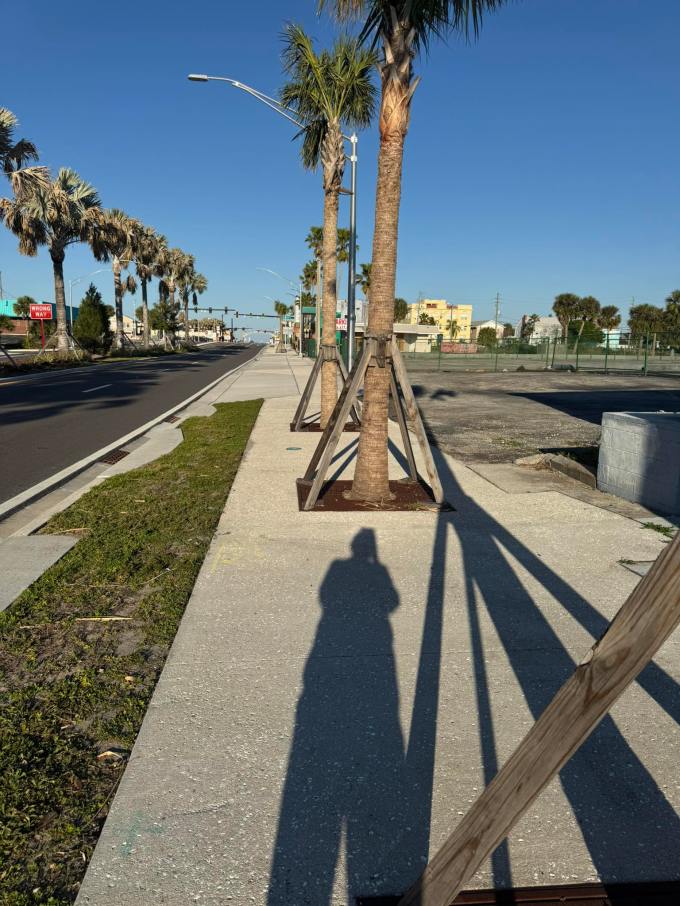
To her credit, Daytona Beach City Commissioner Stacy Cantu did the legwork and demonstrated true concern for her constituents when she took time to investigate the confusing situation.
In a recent social media post, Ms. Cantu reported:
“After hearing concerns from a few residents and seeing a social media post regarding the sidewalk constructed by FDOT on A1A. A photograph taken in the 400 block of East International Speedway Blvd is floating around on social media appeared not to be in compliance with ADA standards. It appears that it is not accessible to persons with disabilities.
I called the proper department within the city and they went out to the exact spot to look at the FDOT constructed sidewalk.
I posted a few pictures down below. It was determined that it meets the minimum standard for ADA compliance. The sidewalk is 29” wide at the narrowest point with tree stakes in place. Once the stakes can be removed including the walkable grate, the walk is 48” wide.
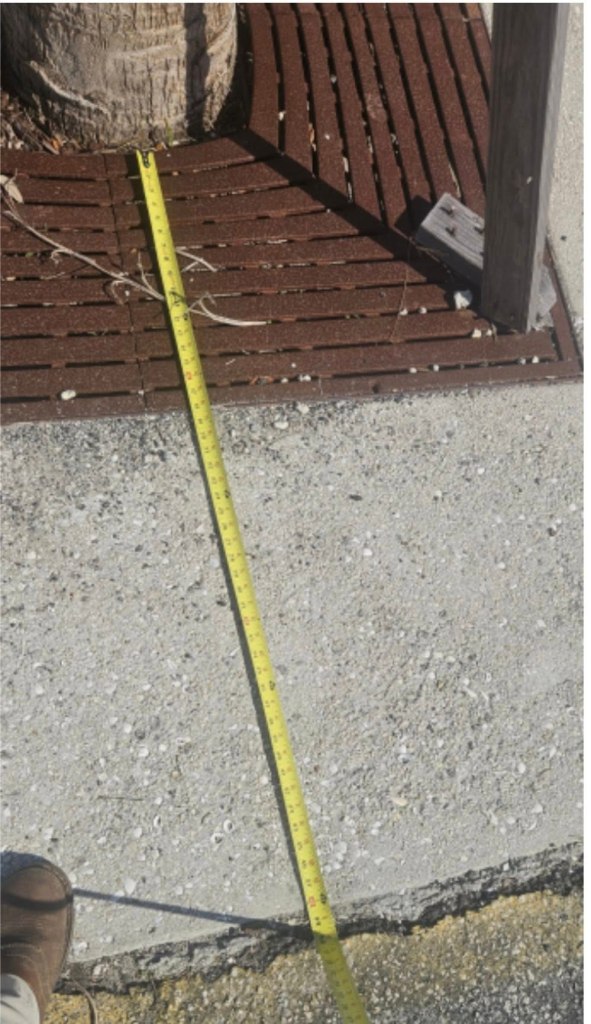
I thank the Public Works department for looking into the issue for the safety and concerns of the residents of Daytona Beach.”
I’ll keep my subjective thoughts on the aesthetics of planting trees in the middle of a sidewalk to myself, and reserve judgement until we see how the detritus that naturally falls from palm trees affects the sidewalk below. It will also be interesting to observe the frequency with which FDOT weeds and maintains those “walkable grates.”
Kudos to Commissioner Cantu for her initiative, leadership, and sense of personal concern for those she represents.
Well done!
Ormond Beach Residents Deserve Answers
In aviation, airframe and powerplant technicians will tell you of the importance of regular engine overhauls. When conducted at regular intervals, this critical maintenance procedure helps ensure optimal performance and the safe operation of an aircraft.
The procedure includes disassembly, cleaning, inspection, replacement of faulty or outdated parts, reassembly, and testing.
A methodical process that increases reliability and ensures all systems are functioning as intended. It can be expensive and time-consuming, but it improves performance and serves as a cost-effective alternative to the catastrophic failures that can result from ignoring recurring issues.
Despite the best efforts of pilots and maintainers, when failures occur, those responsible for investigating aviation accidents do an excellent job of constructing an accurate timeline – determining the chain of errors – that led to the undesired outcome.
This includes a review of human factors (pilot error), aircraft systems, and environmental conditions, a holistic analysis of what happened, and most important, how similar incidents can be prevented in the future.
Given the recent chain of events surrounding Tomoka Reserve, it looks like the City of Ormond Beach’s planning and zoning function is in desperate need of an overhaul and comprehensive assessment.
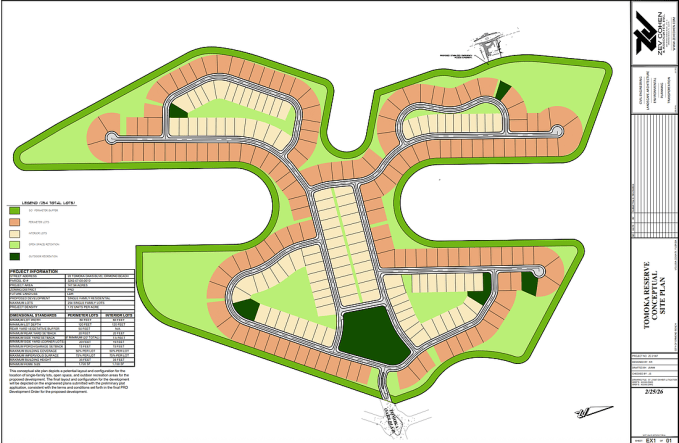
In my role as a political voyeur, last month, I watched one of the most disturbing scenes in memory play out in the City Commission chamber when desperate residents from throughout the community gathered in a final push to convince their bureaucratically hamstrung elected officials to deny a development order allowing 254 homes to be shoehorned onto the former Tomoka Oaks Golf Course.
During that incredibly emotional hearing, over fifty neighbors approached their elected officials – many with tears in their eyes – imploring the commission to throw them a life ring, listen to viable solutions, deny the agreement, and continue the fight to preserve what remains of our increasingly crowded community.
At the end of that heart wrenching scene, the pleas of Ormond Beach residents failed to defeat the pessimistic drone of the city’s legal counsel and senior planning apparatus – who repeatedly assured the elected body that their hands were legally bound – while reinforcing the serious financial implications of fighting the inevitable…
Traumatic events that shake the core of a community should not pass without a thorough review.
It is important to autopsy the facts and circumstances, determine where things went wrong, and most important, how similar problems can be prevented in the future.
Given the widespread ramifications of the Tomoka Reserve debacle, residents deserve something more than another logorrheic screed from Deputy Mayor Lori Tolland explaining, ad nauseum, why she voted to approve the development…

In my view, residents are owed an in-depth review, a thorough examination that culminates in a structured document explaining what happened, identifying lessons learned, and outlining actionable recommendations for future policy, personnel, and legislative changes.
The inappropriateness of the unchecked and unplanned growth that has forever changed the face of this once quaint community has left Ormond Beach resident’s frustrated and confused by the monotonous mantra of planning officials who shrug their shoulders and mewl “Nuttin’ we can do, y’all” while wielding a rubberstamp with the speed and efficiency of a pneumatic hammer…
They are also tired of being surprised by the prospect of having bulk fuel terminals and other direct threats their family’s safety, welfare, and quality of life built in their backyards.
As a result, residents from throughout the Halifax area have grown weary of asking: How could anyone who accepts public funds to serve in the public interest refuse to protect their constituents from the claustrophobic density, sticks-and-glue construction, and bone crushing traffic that is destroying everything that once made this place special?
It’s a legitimate question for all of Volusia County…
Given the intensity and emotional toll of the Tomoka Oaks fiasco, many residents felt that the developers pushing the project didn’t need to hire a land use attorney, claiming that the city’s planning staff did more to facilitate the project than defend the quality and character of their long-established neighborhood.
Right or wrong, it was an authentic emotion from people who suddenly realize things will never be the same again…
That perception/reality was amplified when City Attorney Randy Hayes, having given up the fight, engaged in a tetchy exchange with Mayor Jason Leslie, openly accusing him of lying after Leslie suggested he didn’t have all the facts surrounding the developer’s lawsuit, and indicated he would be changing his vote to deny the development.
I think it’s safe to say that – even with the legislative limitations that drove the ultimate vote to approve – this wasn’t Mr. Hayes or City Planner Steve Spraker’s finest hour…
In my view, Mr. Hayes has frequently been on his heels over the past few years, outpaced and outmaneuvered in a variety of high-profile situations that resulted in the City Commission dissolving into petty squabbles. Backbiting and public spit-spats that allowed several civic issues to turn into politically charged conflagrations that swept the community.
For instance, it appears Ormond Beach has finally selected an employee benefits provider after a monthslong ham-handed process that left many onlookers scratching their heads after Commissioners Travis Sergeant (who works for one of the insurance companies who submitted a bid) and Lori Tolland (whose son works for the same entity) abstained from the vote in keeping with Florida’s ethics laws, yet were somehow allowed to actively lobby their voting colleagues during subsequent discussions (?).
Yeah. I know. It has a whiff of the shit about it…
In my view, the Ormond Beach City Commission has an obligation to determine the who, what, when, where, why, and how of the Tomoka Reserve disaster – then lay bare the good, the bad, and the ugly of how our elected representatives were painted into a legislative corner – and determine why some senior staff members in legal and planning seem completely out of sync with the residents they serve.
So much for the “Fix” we were promised…
“Local governments passed resolutions calling for amending or repealing the law (SB 180). Some joined lawsuits challenging the measure in courts. Others optimistically put off joining lawsuits because surely the Legislature will listen to cities and counties and amend a measure that has only grown more unpopular with time.
“If there’s anything else you’d like to talk about, we’re well aware of SB 180 being a problem,” an irritated Sen. Tom Wright, R-New Smyrna Beach, told a local forum last October. Your elected officials from all around the state were thoroughly sick of all the bellyaching from locals by the time the legislature met.”
And to be sure, the Senate unanimously passed a bill in February to limit the breathtakingly broad scope of SB 180 (SB 840), yet somehow that was the end it. The measure died in committee after it reached the House. It never came to a full House vote.”
–Editorialist Mark Lane, as excerpted from his op/ed in The Daytona Beach News-Journal, “Unpopular Florida law lives on as books close on another session,” Sunday, March 29, 2026
We were told by our state legislative delegation – and those local officials who acquiesced (or were intimidated into silence) – that they recognized the problems inherent to the preemptive overreach of SB 180 and promised a “fix” without the need for challenges and lawsuits.
The sweeping law virtually stripped home rule authority from local governments and preempted land-use regulations under the guise of facilitating “emergency” home repairs following hurricanes.
In actuality, the law gifted developer’s carte blanche to build when and where they want.
In response, several municipalities wrote letters in opposition – Volusia County even genuflected before state legislators, careful not to “stir the pot” as Councilman Jake Johansson put it – offering “suggestions” and begging their forgiveness for having the temerity to question a state edict.

Conversely, the city of Edgewater had the fortitude and independence to join a lawsuit as the provisions of SB 180 threatened the city’s building moratorium that was enacted in the face of widespread flooding.
The Lost City of Deltona initially joined the lawsuit, then turned tail and ran late last year when those capitulating pro-development cowards on the City Commission gained a likeminded majority.
In New Smyrna Beach, Mayor Fred Cleveland wrung his hands in fear, telling his waterlogged constituents scary stories of the threats he received from the state legislative delegation’s toadies on the Volusia County Council:
“I don’t want us to be on the blacklist of those that get punished, one way or another, under the radar. A majority of our county commissioners have said to me we will get punished. And it’s not right, I don’t like it, but it’s human nature … I’m concerned about a suit being our first best step.”
Punished? Blacklisted? That’s not governance – its thuggery.
Last month, Manatee County Commissioner George Kruse explained the intentional blockage of amendments to the law in an interview with Florida Politics reporter Jesse Mendoza:
“The House did everything in its power to find ways of coming up with whatever rules they could do and every game they could play to avoid voting on that thing,” he said. “This wasn’t ‘they ran out of time.’ This was them intentionally not wanting to have this up for a vote. They didn’t even want people on record voting on that thing, that was never getting heard in the House.”
To add insult, around 4:30pm last Friday afternoon (in order to limit media coverage), it was announced that Gov. Ron DeSantis signed a sweeping measure billed as a way to address Florida’s “affordable housing” crisis, a law that further erodes local control of development decisions.
According to a report in Florida Politics by reporter Jesse Scheckner, HB 399 “…requires local governments to tie development fees to the actual cost of project review, adopt more objective standards for evaluating whether projects are compatible with surrounding areas and provide written justifications when denying proposals.
It also directs cities and counties to identify potential conflicts earlier in the review process and suggest ways to resolve them, rather than outright rejecting applications.”
The preemptive law also contains a provision forcing local governments to grant variances to “large destination resorts” effectively bypassing community review processes, public input, and local oversight.
That spiff is something many saw as Gov. DeSantis doing a favor for the billionaire owner of the famous Fontainebleau hotel in Miami who wants a controversial waterpark. As it happens, the owner is said to have donated $1 million to the Governor’s failed presidential campaign while allowing Gov. DeSantis to fly on his private aircraft…
The City of Miami Beach is considering legal action challenging the preemptions.
Sound familiar?
Now, the 2026 legislative session has come and gone without a state budget or the changes to SB 180 we were promised, and with even more preemptions to local growth management regulations.
Anyone see a pattern here?
Now we can expect several callbacks in coming weeks as legislators seek to address everything from the state budget to a half-baked/nonexistent plan to decimate local governments and consolidate power in Tallahassee by “eliminating” property taxes.
As the great editorialist Mark Lane summarized in his Sunday piece, “With so much still up in the air, legislators shouldn’t make vacation plans. Meanwhile, all indications are that counties and cities will be living with the effects of SB 180 for rest of 2026.
Stuck for another year. This could make for some new lively town-hall moments in the months to come.”
Let’s hope so.
In my view, we either stop this blatant power play in Tallahassee now, or live with the claustrophobic consequences of a compromised and corrupt pay to play system forever…
Quote of the Week
“Our municipalities are limited by the State of Florida’s developer-friendly laws and constitution. So, if land is vacant, it will eventually be developed by the property owner (or a future owner with development in mind), and there are few legal routes a city council may take to stop it.
The forces pushing toward more dense development are twofold. One is the market; people want to move here; demand is very high. The other is the state Legislature via two prominent pieces of legislation: the Live Local Act, which makes it easier to build apartments in more zoning classifications, and the Bert Harris Act, which disarms cities of their power to effectively rezone property. In court, property owners and developers have had great success suing cities to claim prior zoning classifications under this law.
The only way to truly prevent a property from being developed is for a public entity, organization or individual to purchase the land and preserve it from future use. DeBary has been doing this for about five years now, acquiring 229 acres to stop multifamily developments and place property under protection. However, we simply cannot afford to purchase every undeveloped parcel.
So here is my proposal: The DeBary Land Bank. By buying property (via a small property tax, about $40 per year), the city will be able to stop overdevelopment of acquired parcels completely and permanently. Yes, this costs taxpayers money, but it pales in comparison to the cost of these monstrosities of apartments that pop up all over the county.”
–City of DeBary Councilmember Jim Pappalardo, as excerpted from his op/ed in the West Volusia Beacon, “DeBary Land Bank: Cities must buy land,” Tuesday, March 31, 2026
Interesting…
And Another Thing!
It’s no secret that here in The Biggest Whorehouse in the World our state legislators have set about neutering and alienating local governments.
Because that’s what their donors in the development industry have told them to do.
Elected and appointed state officials routinely humiliate citizens – the butcher, the baker, and the candlestick maker – with the courage to stand for local elective office, officiously questioning county and municipal spending, while looking the other way as sketchy land deals, local preemptions, and “no-bid” state contracts go to all the right last names in a quid pro quo sham for the ages.
In my view, it’s corruption in plain sight.
That’s disheartening. And it’s getting worse.
Last week, elected and appointed government officials from throughout Flagler County sat submissively as Florida CFO Blais Ingoglia publicly disemboweled them (during an election year) – claiming that “…government is spending too much, government is taxing too much” – while fingering Flagler County as the most wasteful spendthrift in the state.

In keeping with his canned message, CFO Ingoglia stood at a podium adorned with all the right theater props, including one emblazoned “FAFO” – ostensibly signifying the Florida Agency for Fiscal Oversight – but something everyone knows is an acronym for fuck around and find out…
It’s the latest tasteless double entendre the state has chosen to point out “excessive local spending” while hoping We, The Little People will ignore the state’s own drunken sailor routine.
In fact, it was the height of hypocrisy…
According to a report last week in FlaglerLive.com, “Flagler’s officials didn’t say a word, took it, and applauded. The performance lasted 32 minutes. The officials seemed ready for a performance twice as long. None had known what government–county or municipal–Ingoglia would attack.”
More puzzling, the outlet reports Mr. Ingoglia’s appearance was invitation only (?) – attended by a host of county, municipal, and party officials – yet the CFO spoke like he was preaching to the choir, “I’m going to be in this position for another eight years. So, if you think I’m going away and all these are going to stop you are sorely mistaken,” he said.
“I’m not going to stop even with property tax reform,” he said with trademark in-your-face rhetoric. “If you think, just because of property tax reform, I’m going to go away, what do you think, I’m going to give governments a free pass? Heck no, I’m here to protect you guys. I’m not here to protect the government.”
So, when does Mr. Ingoglia plan to clean his own house?
The Flagler County appearance was part of Mr. Ingoglia’s publicly funded campaign tour, a series of dog-and-pony-shows, all similar in nature, where he uses the same script and large cards with even larger numbers on them, to call out (insert local government here) spending.
In my view, the obsequious acquiescence of local elected officials who took their beatdown without so much as a whimper in self-defense was extremely telling.
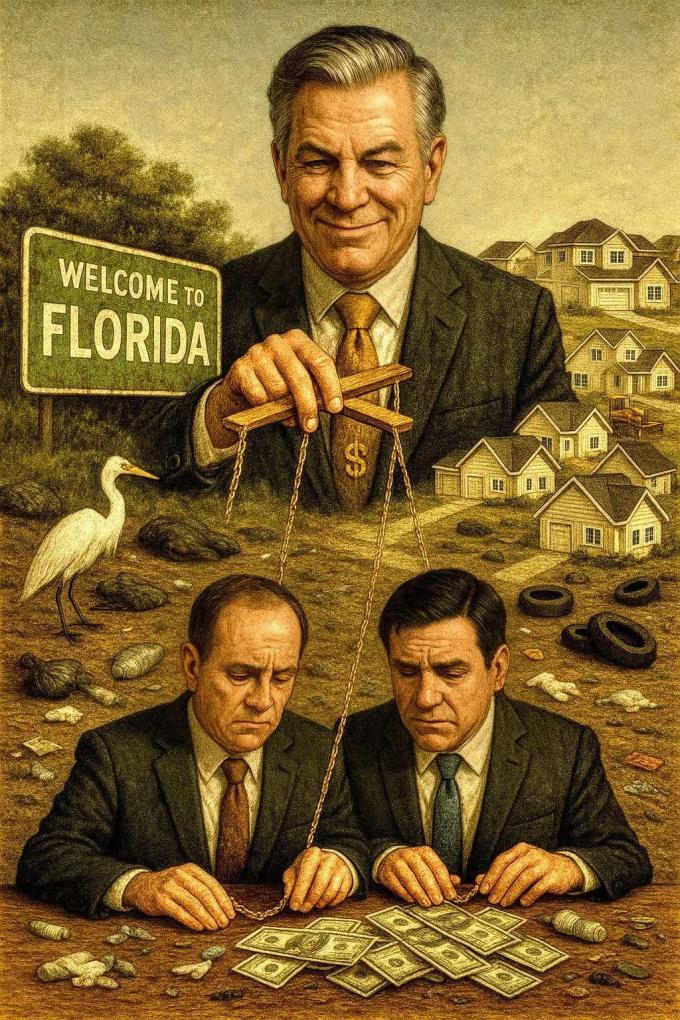
In my view, Mr. Ingoglia’s purpose was frighteningly clear: More optics and political theater ahead of Gov. Ron DeSantis’ swansong…
Following a series of showy audits which used a dubious methodology to prove county and municipal overspending, Mr. Ingoglia is on tour to promote what will eventually be Gov. DeSantis’ politically motivated valediction: The shim-sham of “eliminating property taxes” in favor of – well – we just don’t know.
Neither does Gov. DeSantis, or the state legislature, but facing the most critical decision to the future of Florida in our 181-year existence, they hope to quickly cobble something together to place on the ballot during a “mini session” in a few weeks.
Hopefully after they get around to passing a state budget…
This isn’t about lowering our tax burden or reducing government spending – it’s about power – and who controls it. It is about our right to self-determination through accessible and responsive local government and the essential services it provides.
Our quality-of-life hangs in the balance.
By any metric, Florida is facing a massive crisis of overdevelopment – a hyperaggressive carcinomatosis spreading across the width and breadth of the state – facilitated by a state legislature wholly controlled by development interests who now routinely eliminate local control by preempting growth management regulations.
Local control of our water quality, quantity, and wetland protections is next.
Anything to appease those corporate donors who are directing state representatives to act against their local counterparts – using preemptive legislation, public humiliation, political attacks, and threats to exsanguinate their respective communities by cutting off ad valorem taxes – all in keeping with their Master’s demand to eliminate local development regulations.
Do county and municipal governments have a spending problem?
You’re damn right they do, and local elected officials have no one to blame but themselves for allowing themselves to be kowtowed by insatiable senior bureaucrats each budget cycle.
In my view, the solution to that problem should be left to local voters – at the ballot box – not some bullying state politician with a “Do as I say, not as I do” sandwich board…
That’s all for me. Have a Blessed Easter, everyone!
 Barker's View
Trees, whether palm or deciduous, planted in a middle of sidewalk, surrounded by bituminous, die eventually. Is that not Stricklands zone????
East Daytona ISB residents, that area looks worse than before.
Feacher must step down and the commission must not renew his contract.
Ormond-Welcome 254 more homes, could not have picked a better location to build 254 homes adjoining. Bunch of complainers and winners.
LikeLike